


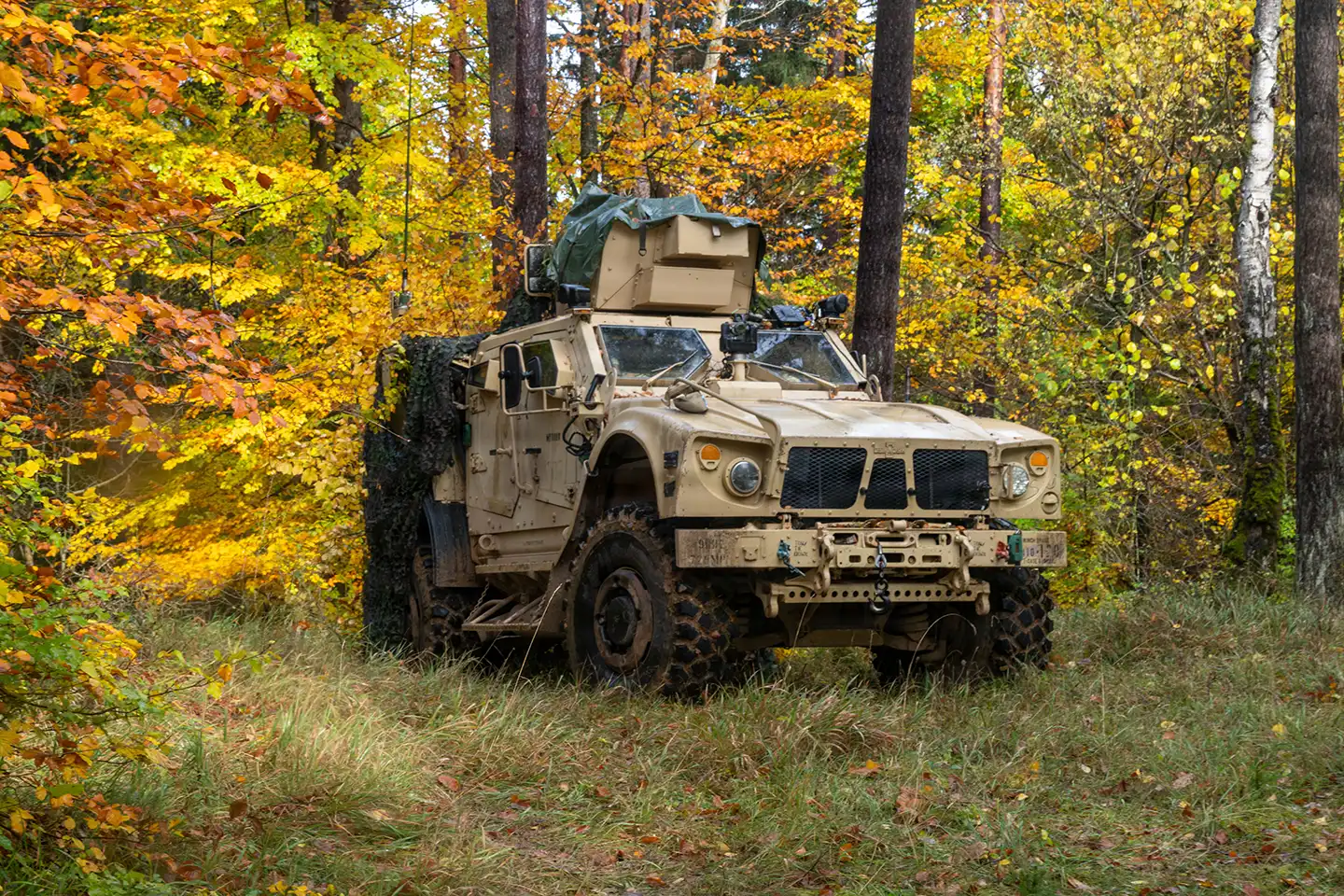
NATO is changing how it conducts core military operations — from command and control (C2) to troop concentrations — as drones extend risk far beyond the front lines. Ukraine’s innovative use of unmanned aerial vehicles (UAVs) in its war with Russia demonstrates the need for this shift as assets and areas that commanders once viewed as secure are now routinely targeted.
Short-range first person-view (FPV) drones, for example, are causing 90% of Russian front-line losses, according to a May 2026 report by the news website Business Insider. Longer-range fixed-wing UAVs are striking Russian logistics hubs and command posts (CPs) in rear areas.
For decades, NATO militaries relied on large CPs where hundreds of officers processed battlefield information. Military analyst Loren Thompson described CPs as “nerve centers of maneuver warfare, continually sending and receiving intelligence, issuing orders to field units, and assuring that the movements of friendly forces are synchronized,” in a 2023 report for Forbes.com. “It is nearly impossible to sustain successful operations in modern warfare without secure command posts,” Thompson wrote.
French Navy Adm. Pierre Vandier, NATO’s Supreme Allied Commander Transformation, told the news website Business Insider in July 2026 that modern battlefield conditions make such CP practices ineffective. Vandier said cloud-based systems now store information and generate analysis without requiring a large staff in one place.
On the battlefield, Ukrainian and Russian forces now shift operations such as mission planning and air defense operations farther from the front or conduct them while on the move. Ukraine’s defense industries also disperse production, with some facilities relocating underground, according to Business Insider.
These experiences from the war in Ukraine and other recent conflicts push NATO toward a force posture that Business Insider described as “more mobile, more discreet and more dispersed.” Vandier, who oversees NATO modernization, said the Alliance’s forces must avoid “useless concentration” and “scatter the force.” The changes will increase European contributions to regional security and make the Alliance stronger and more resilient. This modernization requires not only new thinking on force posture but also a change in how NATO maintains secure communications in combat.
The United States, one of 32 NATO members, is adapting to the changing battlefield through initiatives such as the U.S. Air Force’s Agile Combat Employment concept and the U.S. Army’s experiments with mobile command posts. “U.S. Army planners have learned an important lesson from observing Russian tactics in recent wars: if you want to avoid becoming a casualty, you better not stay in the same place for long,” Thompson wrote.
Assured command, control and communications (AC3) provides the foundation for this conversion, allowing NATO commanders to direct operations through survivable networks even in the most heavily contested environments. The U.S. is incorporating new technologies into a range of current systems — from nuclear command, control and communications (NC3) to the joint all-domain command and control (JADC2) — as well as future ones to develop AC3. The initiative aligns with NATO’s efforts by reducing reliance on large CPs. U.S. Strategic Command continues discussions on these modernization efforts with NATO Allies, including AC3 talks scheduled for September 2026 with Norway and the United Kingdom.
Royal Air Force Air Chief Marshal Johnny Stringer, NATO’s Deputy Supreme Allied Commander Europe, acknowledged the complexity of these modernization changes. “The more distributed it becomes, the more difficult and challenging it is,” he told Business Insider in June 2026.
Vandier also emphasizes the need to achieve “digital transformation at speed” across the Alliance. “There is a [command and control] renewal, which is ongoing,” he told Business Insider. In March 2025, NATO acquired the Maven Smart System, made by U.S. software company Palantir Technologies, to integrate artificial intelligence into operations and improve decision making. NATO also upgrades its intelligence, surveillance, and reconnaissance capabilities. Vandier pointed out that a NATO contract with U.S. satellite imaging company Planet Labs will help to track potential threats, according to a June 2025 Business Insider report. He cited the deal with a commercial provider as an example of how NATO can quickly modernize while strengthening Europe’s self-sufficiency.
“We’ve been able to do that in three months, from idea to delivery. Three months to find the money, make the contract, put that in the field,” Vandier said.