


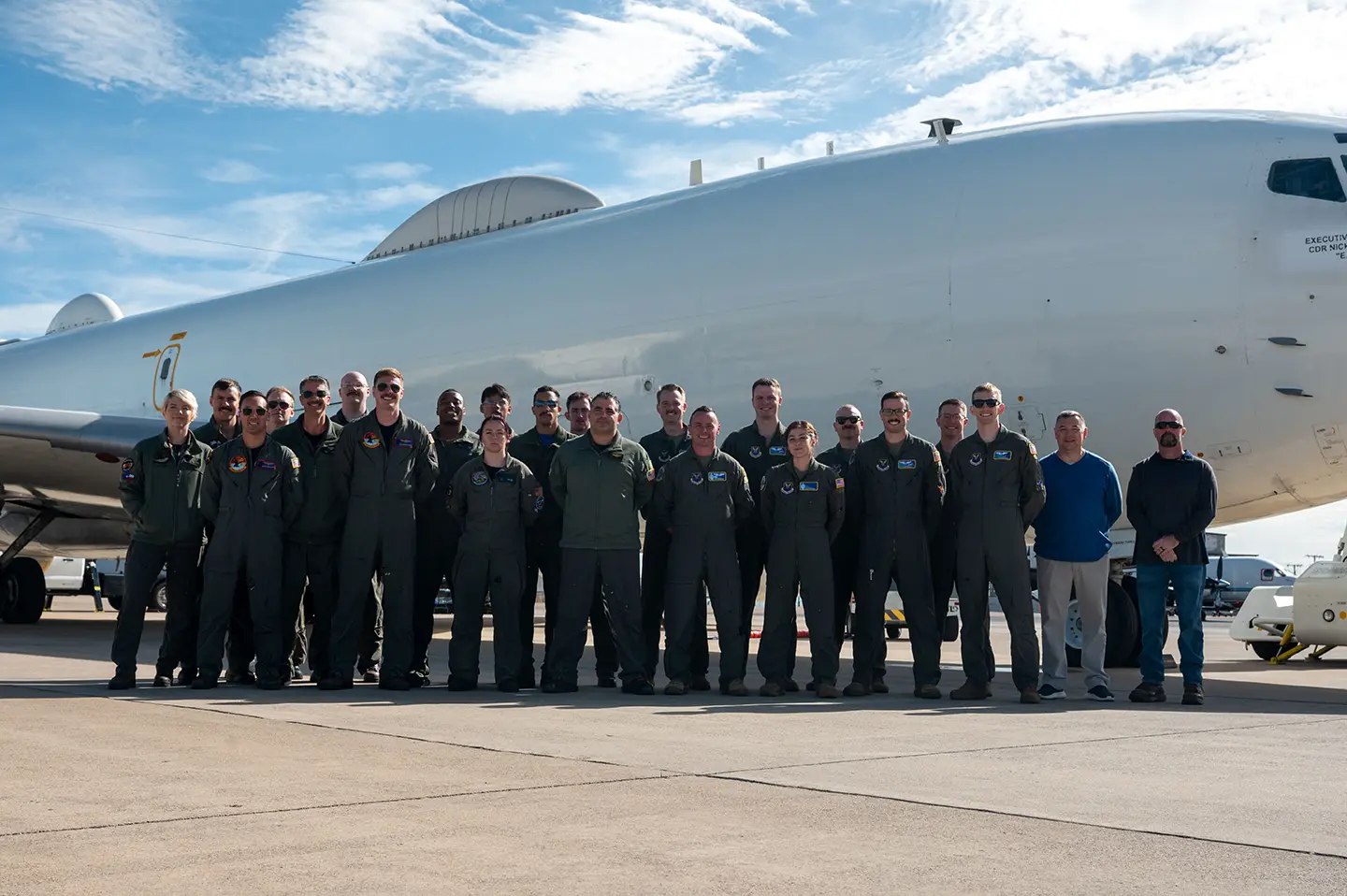
Airmen and Sailors recently gathered at Malmstrom Air Force Base, Montana, to complete a Simulated Electronic Launch-Minuteman (SELM) to validate segments of the United States’ land-based nuclear deterrent. The September 2026 exercise verified end-to-end launch readiness and command and control pathways for the Minuteman III intercontinental ballistic missile (ICBM) system without an actual launch. Personnel from the U.S. Air Force 625th Strategic Operations Squadron (625th STOS) and the U.S. Navy Fleet Air Reconnaissance Squadron 4 participated in the exercise.
“This exercise demonstrates the continued readiness, professionalism and integrated teamwork required to sustain the Minuteman III weapon system,” U.S. Air Force Lt. Col. Chad Redwine, 625th STOS commander, said in a U.S. Strategic Command news release.
The 625th STOS Airborne Launch Control System operators serve as an airborne safeguard, ensuring missiles still can be commanded if ground-based launch control centers are damaged or unable to respond. The test evaluates the weapon system from day-to-day operations through the issuance of the first-stage ignition signal. The goal of this SELM was to verify the weapon system’s secondary launch capability, according to the news release.
During the test, Airborne Launch Control System (ALCS) operators flew aboard a U.S. Navy
E-6B Mercury, sending test commands to launch facilities isolated in their own mini-squadron. Test engineers worked with flight crew and ground teams to track how the systems responded throughout the launch sequence.
“Because of the months of planning and coordination that lead up to a SELM, the crew is thoroughly prepared,” said U.S. Air Force Maj. Quinn Sokolnicki, 625th STOS test flight commander and ALCS operator. “During execution, we as ALCS operators are excited to get actual reps by sending commands to test configured launch facilities at the missile wing.”
The Air Force Global Strike Command (AFGSC) conducts SELMs about twice a year across the ICBM enterprise to verify the readiness and reliability of systems and personnel responsible for the nation’s strategic deterrence mission. While all SELMs share the same core purpose, each event has its own specific objectives. Coupled with live Minuteman III test launches from Vandenberg Space Force Base, California, the data gathered during each SELM provides military leaders with critical insight into how our systems will perform in real-world scenarios.
In June 2026, Airmen assigned to the 91st Missile Wing (MW) at Minot Air Force Base and the 377th Test and Evaluation Group (TEG) from Vandenberg Space Force Base conducted a SELM evaluating launch sequences, command and control protocol, and communication process at Minot, according to a U.S. Air Force news release. That SELM focused on the performance and coordination of 91st MW Airmen, including launch-control center personnel and supporting maintenance and communications teams. Personnel from the 377 TEG provided independent operational testing and evaluation for ICBM systems, helping ensure the enterprise performed as intended.
“SELM testing is a critical assessment of our readiness and precision within the nuclear enterprise. It ensures that every link in the launch chain, from operators to command and control, performs exactly as designed under realistic conditions,” said U.S. Air Force Col. Jimmy Schlabach, 91st MW commander. “By rigorously executing SELM evaluations, we sustain a credible, safe and effective nuclear force that underpins national security and reinforces deterrence every day.”