


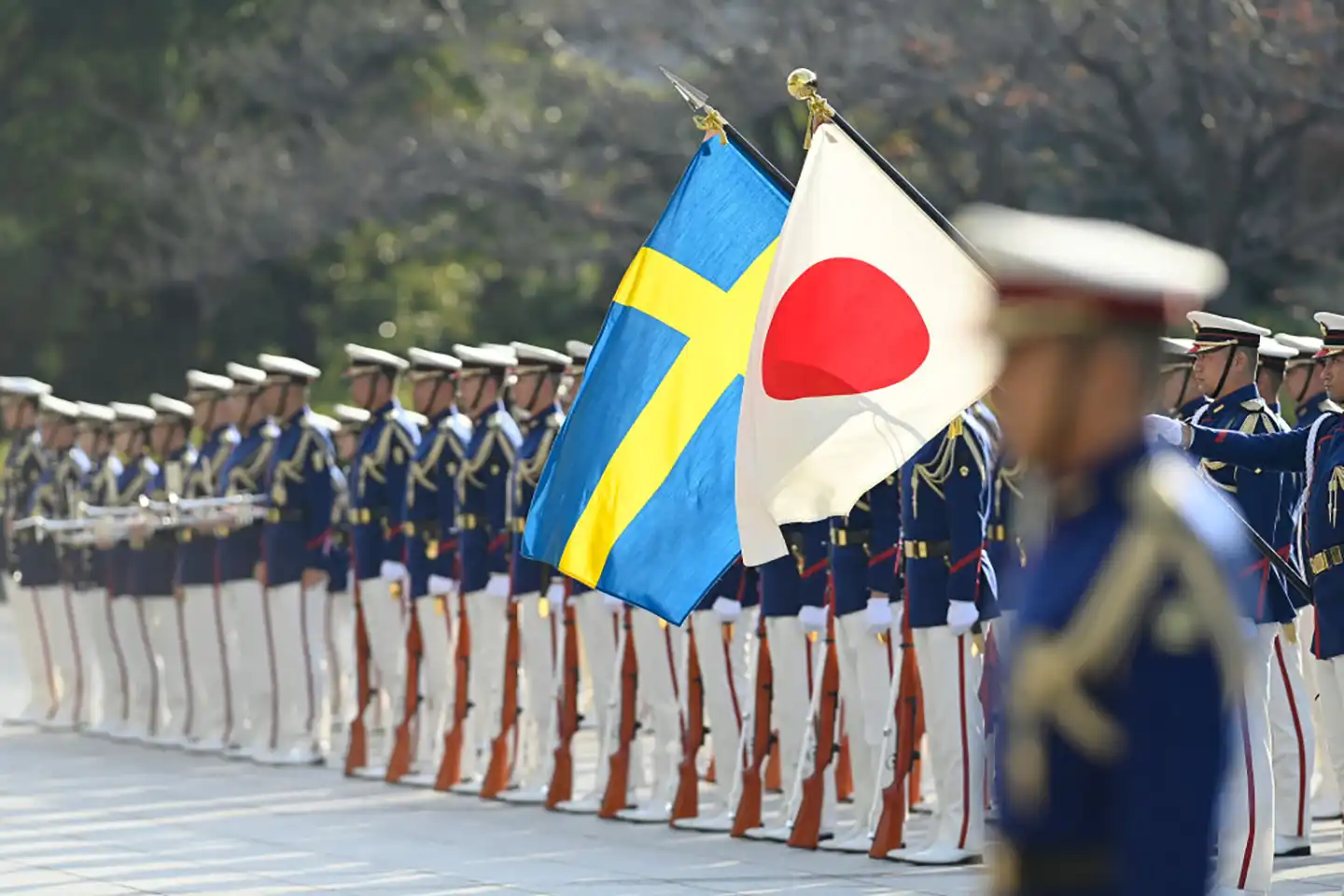
Japan and Sweden are expanding defense and technology cooperation as the two countries increasingly view security in the Euro-Atlantic and Indo-Pacific regions as inseparable.
Japanese Defense Minister Shinjiro Koizumi and Swedish Defence Minister Pål Jonson discussed regional security and bilateral defense cooperation during a July 2026 meeting on the sidelines of the NATO Summit in Ankara, Türkiye, according to a Japanese Ministry of Defense release. The ministers welcomed progress in defense technology cooperation and agreed to promote further exchanges between their countries. They also affirmed the need to cooperate in response to security developments affecting both regions.
The meeting provided the latest indication that Sweden, NATO’s newest member, intends to build a more active defense role beyond its immediate neighborhood. It also reflected Japan’s growing engagement with NATO and individual European allies as developments in one region increasingly affect security calculations in the other.
Russia’s war against Ukraine and its growing relationships with the Chinese Communist Party and North Korea have made that connection more apparent. European and Indo-Pacific countries now face overlapping concerns involving military technology, supply chains, cyber operations, maritime security and attempts to change borders or the international order through force.
Both Japan and Sweden have historic and current troubles with Russia. A Soviet submarine ran aground in Swedish waters in the 1980s, and Russian hybrid operations and sabotage have been conducted there. On the other side of the globe, Russia still occupies Japanese territory in the north that the Soviets unilaterally annex. The increased coordination between Japanese and Swedish forces, therefore, will prove advantageous in countering Chinese aggression in the Indo-Pacific and elsewhere.
Sweden and Japan began laying the foundation for greater cooperation before Sweden joined NATO. The countries signed a comprehensive defense agreement in December 2022, creating a framework for deeper bilateral engagement.
Japan’s defense minister visited Stockholm in July 2024 for talks with Jonson about regional security and defense cooperation. That same year, Sweden adopted its first policy direction for defense cooperation with Indo-Pacific countries.
The policy identifies defense relationships, military presence and cooperation on defense materiel, innovation and technology as Sweden’s three primary areas for regional engagement. It also recognizes that developments in the Indo-Pacific increasingly affect Swedish and Euro-Atlantic security.
Sweden began translating that policy into military activity in 2025 by contributing officers to Operation Highmast, a British-led multinational carrier strike group deployment to the Indo-Pacific. Swedish officers served aboard the force as it operated with regional partners and supported security across the region.
“It is in Sweden’s interests to enhance defense cooperation with partner countries in the Indo-Pacific region,” Jonson said, according to a Swedish Ministry of Defence news release. “This increases our activity and enables us to gather additional knowledge of the security dynamic in the area.”
Sweden’s government reinforced that direction in its 2026 foreign-policy statement, identifying Japan, Australia, South Korea and New Zealand as important NATO partners and pledging to strengthen cooperation with them.
Those four countries, often called the Indo-Pacific Four, have expanded their political and military engagement with NATO in recent years. Their cooperation with the Alliance includes cyber defense, emerging technologies, maritime security, resilience and support for Ukraine.
For Japan, stronger ties with Sweden provides access to a technologically advanced NATO Ally with expertise in air defense, sensors, submarines and defense innovation. Sweden gains a capable regional partner and greater insight into an area that affects global trade, technology supply chains and the wider balance of power.
The partnership remains at an early stage, and the July meeting produced no major acquisition or basing agreement. Its significance instead lies in the strategic direction both countries endorsed.
By expanding defense exchanges and technology cooperation, Japan and Sweden are helping build a wider network of partners capable of responding across traditional regional boundaries. Their emerging partnership reinforces a growing conclusion among NATO and Indo-Pacific governments: Deterrence in Europe and deterrence in the Indo-Pacific increasingly support the same security system.