


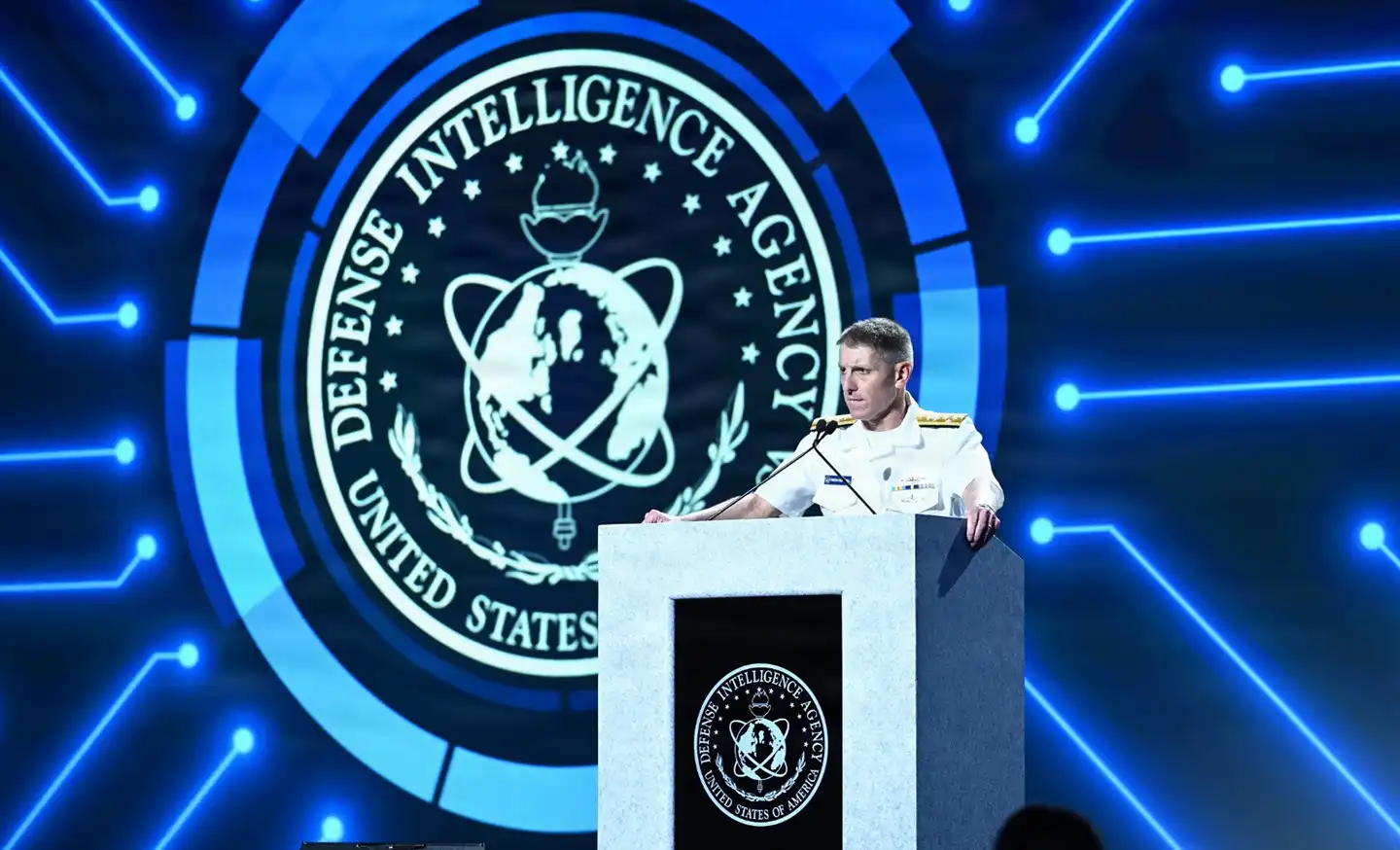
Regional conflicts no longer exist in modern warfare, United States Navy Adm. Richard Correll, Commander of U.S. Strategic Command (USSTRATCOM), told an audience at the DoDIIS Worldwide Conference in Tampa, Florida. “Every conflict is global in the information domain,” he stressed in his August 2026 speech. The Defense Intelligence Agency-sponsored conference draws government officials, U.S. and other Five Eyes military leaders and defense industry partners to discuss intelligence technology. USSTRATCOM’s primary mission is strategic deterrence, and it operates, manages, and plans for the use of the nation’s nuclear Triad, in addition to having the mandate to execute global strike missions.
“The battle over narratives and perceptions begins long before the first shot is fired and continues across social media, state media, cyber operations and diplomatic channels,” Adm. Correll said, according to a USSTRATCOM news release.
One of the clearest examples of this dynamic occurred in 2022, when Ukraine crafted a narrative that enabled it to carry out a successful counteroffensive against Russian forces. Kyiv “harnessed the mainstream media” to telegraph a large-scale offensive it did not intend to execute, according to an Australian Army military education report. Ukraine used public statements and visible troop movements to gain substantial news coverage, prompting Russia to shift forces. The Ukrainians attacked in the opposite direction, routing unprepared Russian forces. “Throughout, the objective was the employment of information to achieve positional advantage and enable a numerically inferior, less-capable force to successfully mass combat power at the decisive point,” retired U.S. Army Lt. Col. David Cowan wrote in Small Wars Journal online magazine. For the U.S. and its allies, such lessons reinforce the importance of integrating information operations early in planning. Information can become a force multiplier when commanders integrate it into operational design from the outset, according to Cowan. That’s because the battlespace is now an environment where the control of data and information is becoming as crucial as the conquest of terrain.
“Nation states are experiencing, with synthetic media, deepfakes and AI-augmented influence campaigns … capabilities designed to influence decision-making and manipulate perceptions, all to constrain political decision space and shape strategic outcomes,” Adm. Correll said. These AI capabilities may allow adversaries to enhance cyberattacks or accelerate targeting processes in ways that compress decision timelines and increase escalation risks, according to Adm. Correll.
“The question is not whether AI will be present in the future conflict. It already is,” he said.
In addition to AI, the threats range from cyber capabilities that target civilian and military communications infrastructure to counter-space weapons that put satellites at risk and to growing conflict across the electromagnetic spectrum (EMS). “The same spectrum that carries our radar, our communications and many of our data links is now a maneuver space in its own right,” Adm. Correll said. These technologies often reinforce each other. Cyber operations can support attacks on space systems, space-based assets enable cyber and kinetic operations, and both depend on access to the EMS and global information infrastructure, according to an August 2026 report by Breaking Defense.
Now, commanders must prepare for operations far from the front lines when conflict erupts.
“We must be able to understand the information environment as a battle space in its own right,” Adm. Correll said, “and we must be able to protect the integrity of the information that underpins our decisions.”