


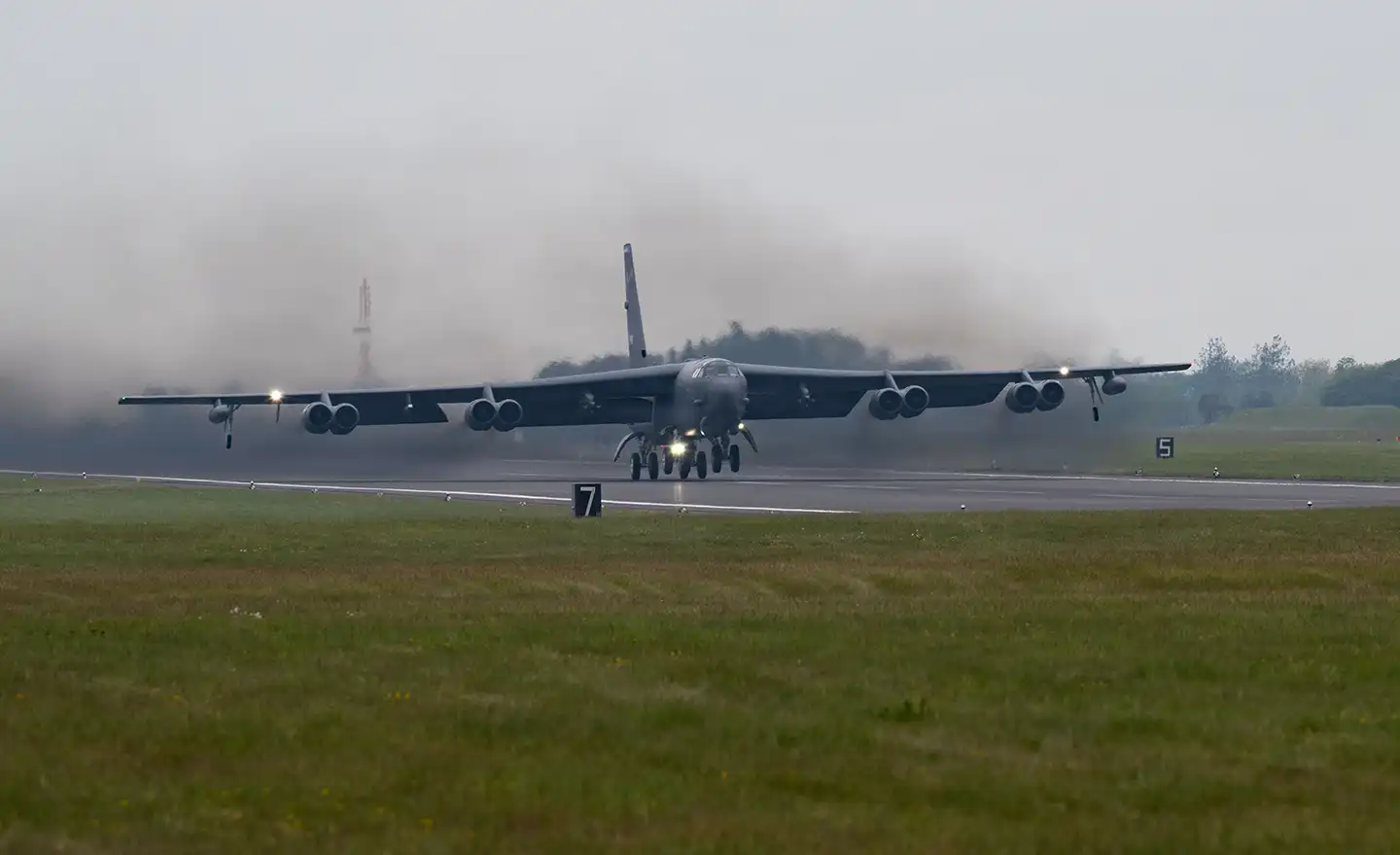
Upgrades to the B-52 Stratofortress bomber are expected to keep the aircraft operational for the next 25 years. The United States Department of War (DOW) announced in August 2026 it would spend up to $766 million for advance work on the new radars and supporting systems.
Under the terms of the contract, Raytheon will build a new AN/APQ-188 radar, an active electronically scanned array radar designed to provide improved functionality and reliability over the B-52’s legacy radar system. The new radar uses a computer-controlled grid of tiny solid-state transmit-and-receive modules to steer radio waves in different directions without moving any physical hardware. The technology replaces previous systems that used rotating antennas to scan the horizon for multiple threats simultaneously, eliminating delays in target detection. The upgrades will replace the bomber’s aging AN-APQ-166 radar across the U.S. Air Force’s 76 active B-52, according to the website Interesting Engineering.
The B-52 Stratofortress, which took its first flight in 1952, has served as a long-range, heavy strategic bomber that can deliver conventional and nuclear weapons. The U.S. Air Force initially began work on the upgrades in May 2023. In December 2025, the first B-52 with the new radar system completed a ferry flight from Boeing’s facility in San Antonio, Texas, to Edwards Air Force Base, California, for flight testing. The contract is expected to be completed in August 2031.
In addition to the radar systems, work to modernize the aircraft includes:
- Replacing 1960s-era Pratt & Whitney engines with modern Rolls-Royce F130 engines
- Updating digital cockpit displays, flight avionics and power generation systems
- Upgrading internal bomb racks and streamlining the nose section
- Updating communications systems
- Removing redundant crew stations
The B-52’s upgrades are expected to extend the aircraft’s service into the 2050s and cost about $21 billion, according to the U.S. Government Accountability Office. The aircraft is part of the air leg of the U.S. nuclear triad, which also includes the B-2 Spirit, a heavy stealth bomber. The triad also includes land-based intercontinental ballistic missiles (ICBM) and sea-based ballistic missile submarines (SSBN).
All three legs of the triad are undergoing modernization. In addition to B-52 work, the B-21 nuclear-capable stealth bomber is in initial production and flight testing. The LGM-35A Sentinel ICBM is in the early stages of development and will replace the Minuteman III. The first Columbia-class submarine, the replacement for the Ohio class, is under construction.
Modernization of the nuclear triad is key to maintaining deterrence, Robert Kadlec, assistant secretary of war for nuclear deterrence, chemical and biological defense policy and programs, said during a March 2026 meeting with lawmakers. “Our modernization programs are an urgent necessity,” he said. “The transition from our legacy systems to a modernized triad occurs during a period of maximum geopolitical risk. There is no room for error.”