


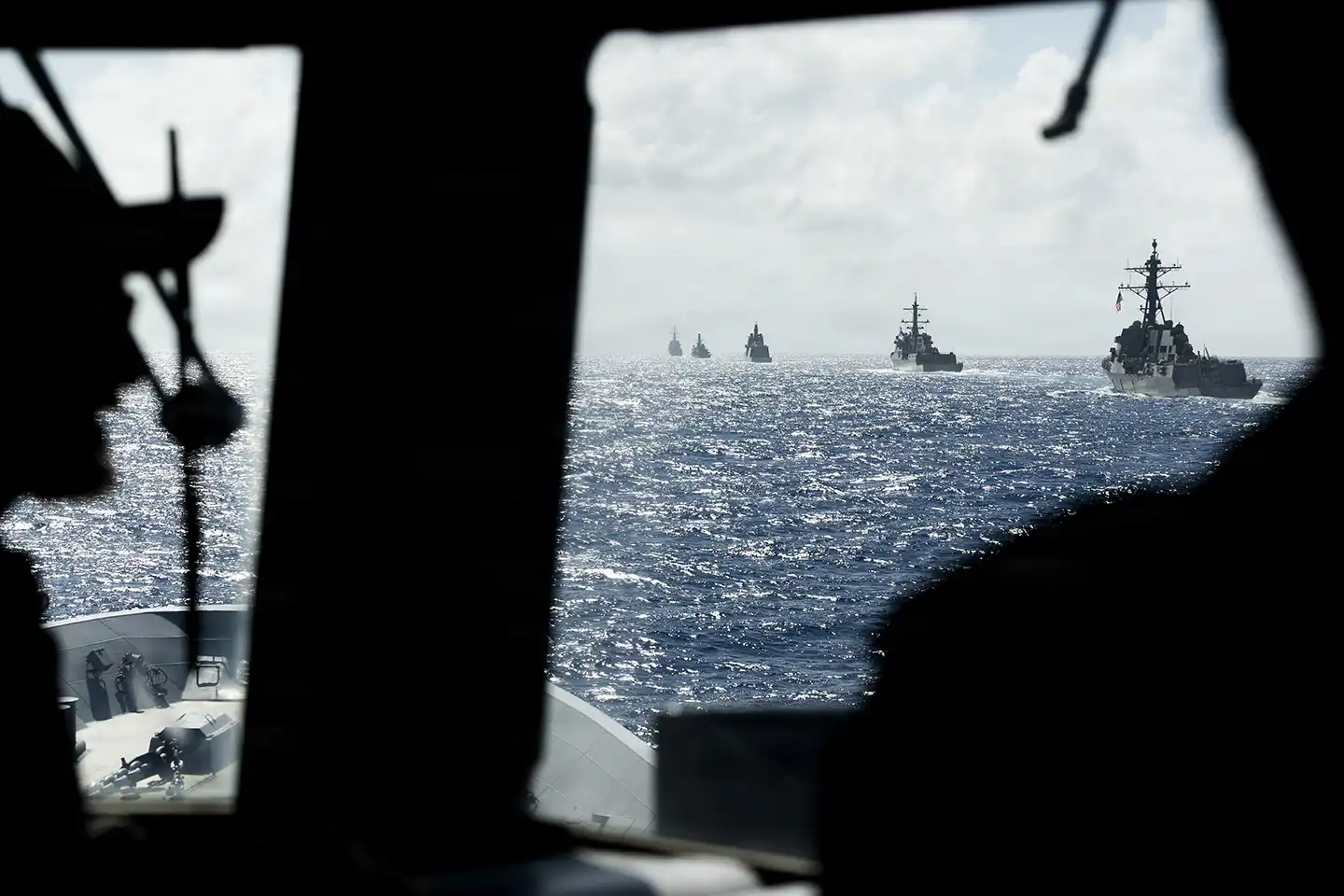
A multinational fleet operating near Hawaii tested the shared sensors, communications networks and procedures needed to detect and track missile threats across the Indo-Pacific. The August 2026 exercise demonstrated how allied interoperability increasingly strengthens regional deterrence.
Forces from Australia, Chile, Italy, Japan, the Republic of Korea, Spain and the United States participated in Pacific Dragon 2026, a biennial ballistic missile defense and tactical data-sharing exercise led by U.S. Navy 3rd Fleet with support from the U.S. Missile Defense Agency.
The exercise combined ships, aircraft and unmanned systems in integrated air and missile defense scenarios. Participants shared tactical information and coordinated ballistic missile defense operations while refining the procedures they would use as a combined force during a regional crisis.
“Pacific Dragon 2026 demonstrates the strength of our alliance and partnerships and our shared commitment to advancing integrated air and missile defense capabilities across the region,” U.S. Navy 3rd Fleet Commander Vice Adm. Marc Miguez said, according to a U.S. Pacific Fleet release. “Through this exercise our forces are strengthening interoperability, improving information sharing and refining the tactics and procedures necessary to operate together in support of regional security and a Free and Open Indo-Pacific.”
Pacific Dragon followed the larger Rim of the Pacific (RIMPAC) exercise, which brought many of the participating forces together near Hawaii.
The 2026 iteration expanded the multinational force by adding Chile and Spain as first-time participants. Their inclusion extended Pacific Dragon’s reach beyond the Indo-Pacific and brought additional members of the Maritime Theatre Missile Defense Forum into the training.
The 12-nation forum helps navies improve cooperation during maritime air and missile defense missions. Pacific Dragon translated that broader objective into operational practice by requiring participating forces to connect different platforms and national systems through shared tactical data links.
Chile participated as the exercise’s only Latin American nation. The Chilean Navy deployed the frigate Almirante Cochrane after the ship completed its participation in the RIMPAC exercise.
“At the same time, it recognizes our institution’s professionalism because we are the only participating Latin American navy,” Chilean Navy frigate Almirante Cochrane Commander Capt. Federico Cavada said, according to a Chilean Navy release.
Pacific Dragon included an in-port phase focused on interoperability and training at the Pacific Integrated Air and Missile Defense Center. During the underway phase, the combined force conducted coordinated operations at sea, including a multimission event that integrated ballistic missile defense with broader air defense scenarios.
Participating vessels included Australia’s guided-missile destroyer HMAS Sydney, Chile’s frigate Almirante Cochrane, Italy’s multipurpose combat ship ITS Giovanni delle Bande Nere and Japan’s guided-missile destroyer JS Kongo. The ROK contributed ROKS Jeongjo the Great, while Spain deployed SPS Álvaro de Bazán. The U.S. contributed the guided-missile destroyer USS Jack H. Lucas, along with P-8A Poseidon maritime patrol aircraft, F/A-18 fighters, MQ-9 Reaper unmanned aircraft and subsonic aerial targets.
USS Jack H. Lucas is the first Flight III variant of the Arleigh Burke-class destroyer. The Navy equipped the ship with the AN/SPY-6 radar and its Baseline 10 combat system, which significantly advanced the service’s ability to detect, track and respond simultaneously to air and missile threats.
Australian components included an E-7A Wedgetail airborne early warning and control aircraft, adding an elevated sensor and command platform to the multinational network. HMAS Sydney also brought the Aegis Combat System, phased-array radar and SM-2 surface-to-air missiles to the combined force.
“The growth in the exercise has been amazing and it’s a great opportunity to build relationships,” Australian Defence Force Chief of Joint Operations Vice Adm. Justin Jones said, according to the Australian Defence Department. Those relationships allow participating countries to progress from operating near one another to exchanging tactical data and coordinating responses to simulated threats.
Pacific Dragon also placed personnel from participating countries inside a combined command structure. Chilean Navy Lt. Joaquín Silva Rosenberg joined U.S. Navy Destroyer Squadron 31 as a liaison officer and future operations planner aboard the Spanish Navy frigate SPS Álvaro de Bazán.
Officers from Australia, Chile, the Netherlands and the U.S. worked within the command post while directing aircraft, unmanned systems, destroyers and frigates from across the multinational force. Together, those systems illustrated a central element of integrated missile defense: A ship or aircraft does not have to confront a threat using only information collected by its own sensors. Shared tactical networks allow one participant to detect a target and distribute that information to other units positioned to track or respond. That ability carries strategic significance in the Indo-Pacific, where vast distances and increasingly complex missile threats demand early warning, accurate tracking and rapid coordination. That reality makes partnership interoperability, and distributed sensing essential to maintaining a credible regional deterrent.
Pacific Dragon tested more than individual ships or missile defense systems. The exercise strengthened the framework that allows allied and partner forces to combine their capabilities, complicate an adversary’s calculations and reinforce their ability to respond collectively.