


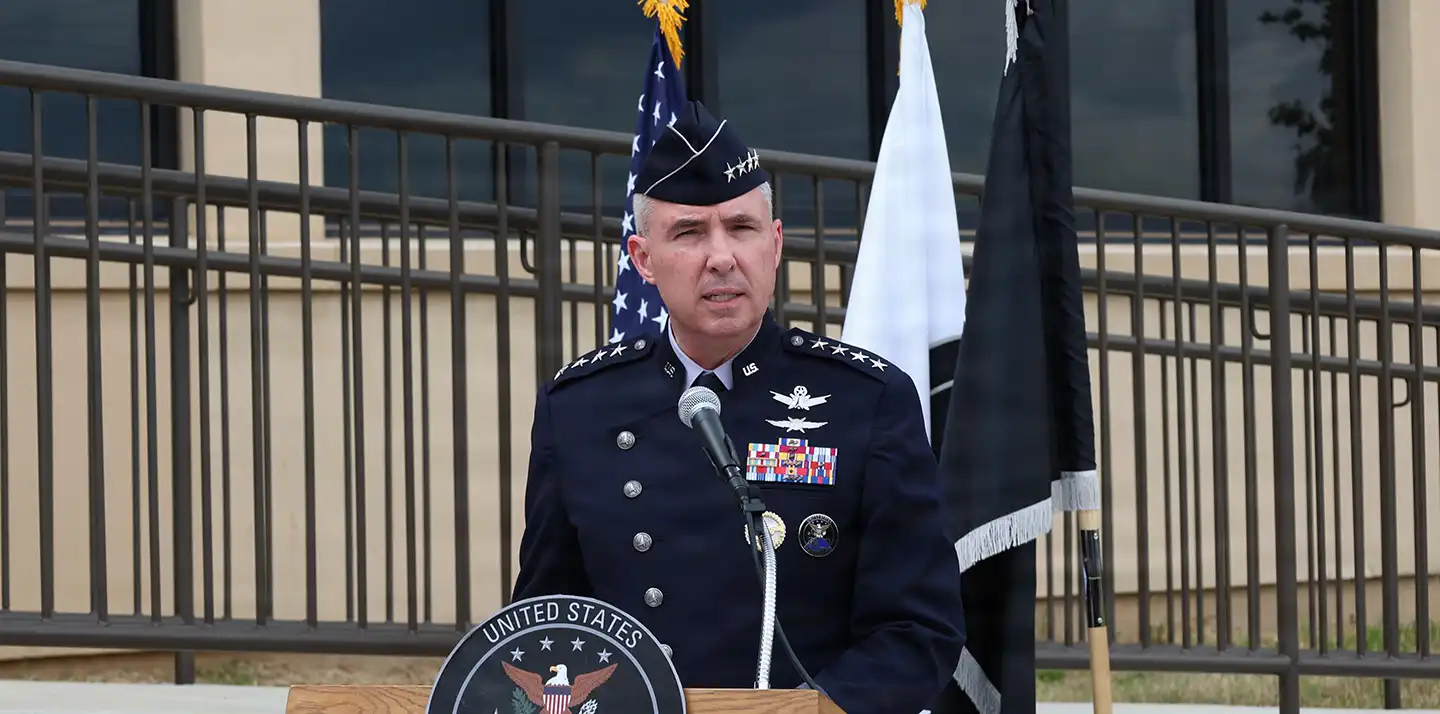
To win battles in space, the United States joint force must have both kinetic and nonkinetic weapons, U.S. Space Force Gen. Stephen Whiting, Commander of U.S. Space Command (USSPACECOM), told defense leaders gathered at the 2026 Army Space and Missile Defense Symposium. As competitors including the Chinese Communist Party, North Korea and Russia develop their own space capabilities, the U.S. and its Allies must continuously work to maintain superiority, he said.
“It used to be that the enemy would aim their snipers and sharpshooters at a platoon leader or radio operator. Nowadays, our adversaries shoot at the space and missile defense units which are deployed inside their weapons engagement zones,” Gen. Whiting said at the August 2026 event, held in Huntsville, Alabama. “Space survivability isn’t just a good to have or a nice to have. It is a need to have.”
Gen. Whiting called today’s security environment an “operational reality of ongoing operations” with continuous threats. “Right now … an adversary is probing our networks. Right now, a jamming signal is attempting to blind a sensor or jam a transponder. And right now, a young operator is holding the line at a ground terminal far from home.”
He emphasized the importance of reliably providing space capabilities to the joint force and U.S. Allies and ensuring these resources are available and effective throughout every stage of conflict.
“If the past few months have taught us anything, if current overseas operations have taught us anything, it’s that our adversaries are targeting space and missile defense assets like never before,” he said. “When bullets cost so much, you take great care with your aim. You only shoot at your adversary’s most valuable targets,”
Gen. Whiting noted that the command has 203 space situational awareness-sharing agreements with Allies, partnerships with 34 nations and dozens of industry partners. “Our strength lies in our partnerships, which are essential for maintaining our competitive advantage in today’s complex and dynamic security environment,” he said.
USSPACECOM is focused on five key investment areas for fiscal year 2027:
- Kinetic and nonkinetic integrated space fires
- Counter-proliferated low Earth orbit (LEO) capabilities designed to degrade, blind or disable massive constellations of adversary LEO satellites
- Joint integrated space command and control
- Dedicated space domain awareness in support of space fires and protection
- Sustained space maneuver. “We must be able to actively avoid threats and maneuver to gain a position of advantage on our opponents,” Gen. Whiting said.
“We operate in a domain in which our opponents have built a suite of counterspace capabilities to hold our satellites at risk in all orbital regimes,” he said. These capabilities include reversible jammers, cyberattack weapons, navigation systems, missiles, high-energy lasers and anti-satellite weapons.
“In space, there is no safe harbor. We can’t dig a trench or build a shield. Our satellites are consistently or predictably in opponent’s engagement zone,” Gen. Whiting said. “We can build the most high-performing, exquisite satellites in human history, but if they depend on fragile, targetable supporting infrastructure, their performance will drop to zero on the first day of the next war.” For the joint force and its partners, protecting space-enabled networks is no longer a niche requirement but a core element of strategic deterrence.